Get a playlist! Standalone player Get Ringtones
Showing posts with label art and artists. Show all posts

Friday, October 08, 2010

Gallery II ~ My Dad

IN THIS SECOND GALLERY POST, I WOULD LIKE TO SHINE THE SPOTLIGHT ON MY DAD, IN HONOR OF HIS BIRTHDAY TO DAY (AND NAME SAINT FEAST DAY LAST THURSDAY, AS I RECALL)...

The drawing above is of Blessed Cardinal Newman, recently beatified by Pope Benedict XVI. It was done with charcoal from a photograph of Cardinal Newman.

Below is an oil painting of St. Bernadette. Dad worked on it for years. My mom and my brothers and I would come down to Dad's studio in the basement after he had spent all night awake painting and study the painting. Sometimes it was hard to tell what he had worked on all night, but other times it quite caught our breath away. my brothers and I refer to this painting as 'Dad's masterpeice'.


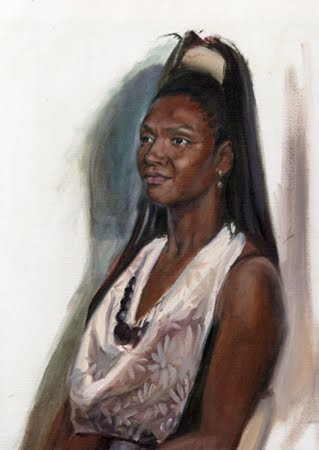
My dad has gone and still goes to several art clubs where artists will get together to paint a model. This is one his best from those sessions.

And here is the link to Dad's blog where you can find photoes of some more of his work: http://http://runartist.wordpress.com/


Feel free to comment on my Dad's blog!

Friday, February 19, 2010

ART IV ~ The Problem of the Artist

So far I have stupidly left out a huge piece of art: the artist. So, I shall discuss the artist, using the Catechism of the Catholic Church as my guide. So, once again, let's read CCC 2501:
Created "in the image of God," man also expresses the truth of his relationship with God the Creator by the beauty of his artistic works. Indeed, art is a distinctively human form of expression; beyond the search for the necessities of life which is common to all living creatures, art is a freely given superabundance of the human being's inner riches. Arising from talent given by the Creator and from man's own effort, art is a form of practical wisdom, uniting knowledge and skill, to give form to the truth of reality in a language accessible to sight or hearing. To the extent that it is inspired by truth and love of beings, art bears a certain likeness to God's activity in what he has created. Like any other human activity, art is not an absolute end in itself, but is ordered to and ennobled by the ultimate end of man.
Let's analyze this, breaking it down sentence by sentence...
1. Man is created in God's image; he expresses that in the beauty of art.
2. Art is specifically a human endeavor; it is a generous expression of the riches in a human.
3. Art arises from talent and effort, and it unites knowledge and skill in a form of practical wisdom for the purpose of giving form to the truth of reality in languages that we can see and hear.
4. As it is inspired by truth and love of beings, it is like God's creating.
5. Like anything else human, it is not an end, but it has order and nobleness from the end of man.

As you can see, there are some very important connections being formed here. First let's consider the one stated in sentences One and Four: 1. That man's making art is like God's creating man 2. because both are inspired by truth and love of beings, and 3. that this relationship is expressed in the beauty of art.

Adam in the Garden of Eden

1. Man's making art is like God's creating man- we are created in God's image, and the art that we make somehow reflects us. An effect always is similar to its source, or cause, because it has nothing of its own but what came from the cause. Even when an artist says a painting took on a life of its own, the painting is still coming form the artist, just in very unexpected and surprising ways.

Painting by Michelangelo on the ceiling of the
Sistine Chapel, showing God creating Adam


2. Both God's creating and man's making art are inspired by truth and love of beings- Love naturally spreads to include more and more people, which is evident in how a family begins as man and wife and spreads to include children. God did not need to create anything, but being love, He wanted to extend love to more beings. as the Catechism says in paragraph 1, "God, infinitely perfect and blessed in himself, in a plan of sheer goodness freely created man to make him share in his own blessed life." God's love for us, and the truth of His love, and the Truth which God gives us because He loves us continues and will continue for all time; that is "God's activity in what He has created." Art comes, more or less, from the artist's observation of truth within or outside of himself, and for love of some being. This calls to mind two quotes from the Introduction of Caritas in Veritate by Pope Benedict XVI: 1. "love and truth never abandon them (all people) completely, because these are the vocation planned by God in the heart and mind of every human person." 2. "Truth should be loved and demonstrated."

Painting by Jack Hayes of Michelangelo painting the Sistine Chapel

3. This relation is expressed by the beauty of art- As we said in 'ART III~ The Problem of Beauty', the more a things is beautiful, whether in a sensual or intellectual way, the more a thing is like God, who is the most beautiful. So it is in the beautifulness of art that the viewer, or audience, can grasp the profound relationship he, the artist, and all people have with God. It is through beauty that lies one of the clearest ways of leading our thoughts to God. God directly manifests Himself in the beauty of creation (also discussed in 'The Problem of Beauty'). People directly and indirectly, intentionally and unintentionally, manifest their Creator and their relationship to Him in art.
Then it seems that when art does not reflect this relationship in a good way, but rather distorts it and mocks it, it is a great sin. For the relationship between man and God is sacred.
Lucifer by Jackson Pollock
Further posts concerning sentences 2, 3, and 5 are on the way!

Wednesday, February 10, 2010

ART III ~The Problem of Beauty

There are two posts already on my blog that deal directly with art: 'What is Art?' and 'Art Is.....?' I am now going to continue my discussions of art, dealing with this question: in the first post I said, "Beauty and Truth are far from always agreeing. But in art they are shown as sisters." Then, in my second post I had a huge quote from the CCC, and one of the things it says is: "Truth is beautiful in itself." The problem is, are truth and beauty opposed or is truth beautiful in itself?
As always, the best place to start is to define our terms. Truth is a correspondence of reason and reality. Beauty is... And this is where we run into problems. As we all may attest, I am sure, the wonders of creation lead us to consider the greater wondrousness of the Creator.


3 [...]let them know how much the Lord of them (fire, wind, stars, the sun, etc.) is more beautiful than they: for the first author of beauty made all those things. 4 Or if they admired their power and their effects, let them understand by them, that he that made them, is mightier than they: 5 For by the greatness of the beauty, and of the creature, the creator of them may be seen, so as to be known thereby. ~Wisdom 13:3-5

And that is the closest thing I know to an actual definition of 'beauty'.
So, beauty was made by God with the purpose of showing by it His own beauty, and so reveal Himself. In human works, beauty has the mission of showing some truth. In creation, beauty has the mission of showing the Truth.
We observe beauty through two things: the mind and the senses. As it says in the definition of beauty at dictionary.com, '
The quality that gives pleasure to the mind or senses and is associated with such properties as harmony of form or color, excellence of artistry, truthfulness, and originality.' (emphasis added) This is where the whole problem of defining beauty comes up, I think. Because when we think of what is beautiful, we tend to think of things like this:


Or like this: Rapsodia Romania (op.2) by George Enescu
These are all beauties that reach to the senses, and can lead us higher than the senses ever will be able to. It was in thinking of these sensual beauties only that I wrote that beauty and truth were often opposed. I was thinking along the lines of, 'A lie may sound perfectly marvelous, but it isn't true. It may be true that someone is dead, but that isn't beautiful.' And so I cam e to the conclusion that beauty and truth are often opposed. If the only sort of beauties that existed were the sensual kind, then I am right.
However, there are also things which are beautiful, and whose beauty only the intellect can grasp, things which may even repel the senses. For example, suffering and death. How can they beautiful? Although it seems almost impossible to see these as beautiful, they are, because they can lead one closer to God.
As the senses have 5 faculties, so the mind has 5. One of these is the intellect, which has the ability to sense what is beautiful, even of the senses cannot or will not. Consider again the definition from dictionary.com:
'The quality that gives pleasure to the mind or senses and is associated with such properties as harmony of form or color, excellence of artistry, truthfulness, and originality.' (emphasis added) One cannot see, hear, taste, feel, or smell truthfulness. But one can sense when what they see, hear, or feel is true- with the intellect's sense for what is good, true and beautiful.
So, now that we have explored what beauty is and how truth and beauty can be opposed of one is only thinking of sensual beauties, let us find how they correspond, when thinking of both sensual and intellectual beauties.
As Wisdom 13:3-5 shows us, sensual beauties that are created by God, such as fire,wind, stars, and the sun, can and should lead us to God. Thus they correspond to Truth. Sensual beauties made by man- clothes, paintings, sculptures- are an imitations of the created; others like photos and videos are ways of holding the created from the changes of time. These can lead us, indirectly, to the Creator. The purer they are of sin, the more they do this.
Intellectual beauties, both created and made, correspond with truth and the Truth because God is beautiful. We know God is beautiful because, as said in Wisdom 13:3-5, the beauties of earth reflect that. If He were not beautiful, He would not be able to have made anything beautiful. Also, all that is the best is in Him, so if there is beauty in creation (there is), then He is the most beautiful (He is). (There is a slight distinction I will make before going on: the beauties of the earth are a means for us to reach Him, mentally and actually. The beauty of God is an end to be contemplated and enjoyed here and forever in heaven.)
Now, God is beautiful and God is Truth. As He is all perfect, there cannot be anything contradicting in Him, so his beauty and Truth must perfectly be in agreement. Thus, the Truth is in itself beautiful. Going down now in thought, from greatest to least, we may conclude that the more a thing is like God, the more it is true, the more it is beautiful, and the more these two qualities agree and compliment each other. And the less a thing is like God, the more sinful and low, the less it is true and beautiful, and the less these agree.
Specifically, on the example I gave of an intellectual beauty- death. Death is the way that, because of sin, we have to pass through to get to heaven. But the end of all things, God, has purified and made holy our only means of actually reaching and being with Him eternally in His full glory. So, death not only has beauty in that is a way to the greatest beauty; it now is a beauty in itself, a sanctified way, and when we go through it we are following in the footsteps of God.
Finally, if even death, the greatest effect of sin- ugliness and lies- can and has been sanctified and so made good and holy and true and beautiful, then we can know that truth and beauty are not opposed. When they seem opposed, it is probably because one of them is either lacking or impure, or our senses intellects are dulled and warped by sin and so we cannot see or think correctly.
And now, I big thanks to you, my reader, for having read that humongously long post!

Saturday, November 28, 2009

ART II ~Art is..........?

Thanks to Tolstoy's What is Art? I've been thinking about art a lot lately, and I've come up with this theory:

Essentially, art is the portrayal of truth through beauty; by doing this, it can reflect the goodness of God and lead to contemplation of things eternal.


I have charted out the components of Art in this way:


In art, beauty serves truth, but the relationship between truth and beauty do not have to be 50/50. Still, every component has to be there for it the work to merit the name 'Art'. art also has a relativity in that what some people call art others call junk. This is because what appeals to some people's senses is repulsive to others, what some people consider reasonable others think is stupid and nonsensical. I think people can pretty much agree on what reflects reality and what is orderly.
Notice that Order and Reason are more internal and mental qualities. Reason is an action of the mind, and order is something perceived by the mind. Meanwhile, appeal to the Senses and Reality are more physical and external qualities which we learn through our senses and through experience.
Now, I said in my theory that art can lead to the contemplation of the eternal. This ability and its effectiveness depend on two things: 1. the artist(s)' intention and his/her/their ability to fulfill the intention 2. the mental capacities of the audience.
Considering the first, no mater how much a person has a good intention, if they can't portray it, the art is stuck in their heads. This is why talent is such a huge thing to be an artist. As my friend pointed out, you can fix technique, but not talent. The talent of art is a God-given gift, and those with it have the ability to communicate well their intentions, to lead to truths beyond the senses by appealing to the sensible. The problem is when the intention is wicked and sinful. I cannot think of any situation when such an 'art' would lead beyond the sensible. Moreover, truth is a good thing even when it is far from beautiful. When exposed to such 'art', which I cannot quite consider merits the term 'art', the right thing to do is to avoid it and all temptations it will give.
Considering the second, no matter how simply the artist portrays the truth, if the audience is hopelessly or obstinately stupid, they won't understand, and again the art will by stuck in the head of the artist. So when viewing or listening or watching art, one should try to hear what the artist is saying, no matter how hard. If there is no message, mere beauty, then it is not art but mere beauty. Remember, however, that one person may get nothing from a work of art while others get very much, and so what may be mere beauty to one might be art to another.
To summarize, let's read one of my very, very, very favorite passages from one of my very, very, very favorite books:

2500 The practice of goodness is accompanied by spontaneous spiritual joy and moral beauty. Likewise, truth carries with it the joy and splendor of spiritual beauty. Truth is beautiful in itself. Truth in words, the rational expression of the knowledge of created and uncreated reality, is necessary to man, who is endowed with intellect. But truth can also find other complementary forms of human expression, above all when it is a matter of evoking what is beyond words: the depths of the human heart, the exaltations of the soul, the mystery of God. Even before revealing himself to man in words of truth, God reveals himself to him through the universal language of creation, the work of his Word, of his wisdom: the order and harmony of the cosmos-which both the child and the scientist discover-"from the greatness and beauty of created things comes a corresponding perception of their Creator," "for the author of beauty created them."290

[Wisdom] is a breath of the power of God, and a pure emanation of the glory of the Almighty; therefore nothing defiled gains entrance into her. For she is a reflection of eternal light, a spotless mirror of the working of God, and an image of his goodness.291 For [wisdom] is more beautiful than the sun, and excels every constellation of the stars. Compared with the light she is found to be superior, for it is succeeded by the night, but against wisdom evil does not prevail.292 I became enamored of her beauty.293

2501 Created "in the image of God,"294 man also expresses the truth of his relationship with God the Creator by the beauty of his artistic works. Indeed, art is a distinctively human form of expression; beyond the search for the necessities of life which is common to all living creatures, art is a freely given superabundance of the human being's inner riches. Arising from talent given by the Creator and from man's own effort, art is a form of practical wisdom, uniting knowledge and skill,295 to give form to the truth of reality in a language accessible to sight or hearing. To the extent that it is inspired by truth and love of beings, art bears a certain likeness to God's activity in what he has created. Like any other human activity, art is not an absolute end in itself, but is ordered to and ennobled by the ultimate end of man.296

Monday, November 09, 2009

Life of an Artist

I


Little girl sitting at the dining room table. Before her is a sheet of paper, and on the paper is a large, black circle. Around the circle is gray, like a gray doughnut with a huge black hole. A black hole. Around the gray is a squiggly line of purple. She can't think what more to draw. She pokes the purple crayon, rolling it along the edges of her paper. She looks at the black circle, ponderously. Her name is Cassandra. She-! Did the black hole just move? It seems to quiver. Not the black wax on the white paper but something Deep in the picture quivered. Cassandra shakes her head, quivers to break her concentration. And when she looks back at her drawing, she is very small.
She is very, very small. The little girl sitting with her chin in her fisted hands at the edge of a black hole. Behind her is gray. In the far horizon is a ring of squiggly purple. Before her is black and black and black. 'What is black?' She wonders. 'Is it anything more than this color?' But her questions are only little quiverings in her mind. She does not know how to say them, for she does not know the right words. Her thoughts are prisoners of her wordless mind.


II


Veins of white, where the black wax did not quite meet, ripple through the black hole. The veins are slitting farther. The peices of black are splintering apart. Where they shift, the paper under them glares white. Something deeper than the paper, nearer than the wax, is stirring. Something is moving and moving everything else. The gray throbs and the purple squiggly line, far in the distance, squirms uncomfortable.
Steady, up and down; up - the living thing under the black wax is trembling - violently. The white cracks, like lightening, shoot to the edges of the black. The gray heaves and lowers, vomiting a gray minst. Heaves and lowers. The purple squirms and rises. It is a ring of electric fury, snapping and flexing. It sends out purple and orange sparks. The enormous drawing comvulses in rhythm, as if it has a pulse.
The girl waits for the living force with a pulse to come out. She knows it will come out. Chunks of black wax are being rent from the paper and flung. They hurtle outwards. Just as they are about to smash down into the gray fog, they rear upwards. They lift and wheel around the black hole's edges. Cassandra watches all this. . . astonished. The chips of black wax are circling evenly, like horses on a carousel.
Little girl waiting. Waiting with her chin in her fisted hands, but nothing comes out of the black hole. 'How did my picture come alive?' She wonders wordlessly. 'Where did its life come from?' But there is no one to answer her questions. No one who can understand them. No one. The girl is entirely alone. She sits and waits, but there is nothing in the black hole.
There is more black orbiting in the air than black on the paper. Only a few specks of black still cling to the very, very blank white paper. The paper is empty of any secret. Cassanra walks into the center of the paper where the pulsing thing was supposed to be. There is a Deep pulsation, but it is so low she can barely hear it. But she feels it. Everywhere she feels it. She stands in the center of the very, very empty paper. But there is no wiggling beast giving her drawing life. There is only Cassandra. And the pulsation. The pulsation is very heavy here. She feels it in the edges of the paper, in the sparking, flexing purple line. She feels in it the heaving, vomiting gray mist, and the circling chunks of black wax, and along her skin. She feels it in her blood. It is a heart beating, heart of the little girl.


Monday, October 26, 2009

Sacred Music - the playlist

Every other month for a month I listen to a specific composer or genre of music ONLY. This month, the 27th of October to the 27th of November, I am dedicating to religious, prayerful music. So, there is a new playlist of religious and prayerful music on my blog. On the 28th of November I will reinstall the original 'Cogito et Scribo' playlist.

While on the topic of religious Music, there is a wonderful paragraph from the Catechism of the Catholic Church on sacred Art:


Sacred art
is true and beautiful when its form corresponds to its particular vocation: evoking and glorifying, in faith and adoration, the transcendent mystery of God - the surpassing invisible beauty of truth and love visible in Christ, who "reflects the glory of God and bears the very stamp of his nature," in whom "the whole fullness of deity dwells bodily."297 This spiritual beauty of God is reflected in the most holy Virgin Mother of God, the angels, and saints. Genuine sacred art draws man to adoration, to prayer, and to the love of God, Creator and Savior, the Holy One and Sanctifier.

Friday, September 25, 2009

Nothing to say

I have nothing to say.
I want to wrote something, something
beautiful and lovely, like
folds of green gossamer
that ripple like water,
but I have nothing to say.

day drifting and another
hour to go, and homework
and all that sort of rot.
But it's not much of anything
when you have nothing to say.


When all that you feel
is sound and dance
but all that you have is words
and repetition and a nice
reputation and you
are caught up in now,
a now not worth having

and you have nothing to say
to the lilting green day
as it whispers and passes
you by. You are mute
and alone in a land all a dream
of what could be- unworded
and you have nothing to say.

Tuesday, August 18, 2009

4 kinds of music

There are, I believe, four categories into which all music can be divided, according to one's reaction when the music is over:
1. The kind of music you don't even bother to hear till the end.
2. The kind of music that when it is over, makes us glad it is over.
3. The kind of music that when it is over, makes us replay it in our minds and wish it had not ended quite so soon.
4. The kind of music that when it is over, makes us cry because it leaves the air empty, absolutely hollow like a body whose soul has just abandoned it.

(thank you, Paul, for your input)

Tuesday, July 21, 2009

For most of us reading, whether prose or poetry, is a form of entertainment. At times if we find our own life disjointed and our reactions to some situations beyond clear, reasonable explanation, literature offers us the opportunity to look at patters of human life and contemplate them from a distance. If the writers are good, we can see parallels with what we have experienced and causes and effects make sense. According to one English teacher, "Fiction gives us little universes to ponder, to discuss with others, to marvel at and question."

from a lecture handout

Monday, July 06, 2009

So, I had to write this essay for my English Composition class. I think it's worth reading.

Music, Who Am I?

It was all Socrates’ fault. He said that one can tell who a person is by what they listen to. I desperately wanted to know who I was, and I was determined to discover the truth is this assertion.

I remembered how on the last days before my three most recent birthdays I had watched the hours end, one by one. It was like trying to hold the waves as the river dragged me onward. Then, shortly before my seventeenth birthday, I heard the song “From a Distance” played by flutist James Galway. I instantly associated it with growing up, and the song became a source of steady hope and my window through which I looked back at my past and forward into my future. On the last day before my seventeenth birthday, I thought of that song and all it was to me; I did not count the hours.

I recognized this as proof that music did indeed shape me, perhaps even who I was. I decided to test Socrates. I don’t know who I, a stupid American teenager, thought I was to challenge the unquestioned wisdom of an ancient Greek philosopher.

For one month I did not listen to music. I hoped I would discover my essence, uninfluenced by music. In the silence, I became more perceptive of sound, and as my ears sharpened, I grew to rely on them more than any other sense. A strong connection developed between what I hear and how I consider my life and surroundings.

I became acutely aware of the evils of the world, perhaps because I was listening more than ever before. The world struck me as horrific, resonant with hatred and deception. My friends were disappointing me; my parents expected me to make choices I was not ready for, and I was hungering for something I hardly believed in. The chaos of others’ voices and my own faults strangled me. My mind was jarred with raucous noise. With increasing panic I struggled to understand it all- society, immorality, people. Yet I did not even know how to perceive the world. Truth and falsity are too tangled. What was I to do? How was I to react? Below all this was a throbbing hope that there might be a universal truth to summarize, unite and explain all people, including myself.

Also at that time, I found everyone wanted me to be happy and nice. It was like a sheet of smoky glass surrounded me. People only saw of me what they wanted. When I did not smile, they would laugh and say, “Smile! The sun is shining.” They did not listen to what I was trying to say. I would flounder for any answer to their questions and hope they would hear the hypocrisy in my voice as I said something I did not believe. But I was saying what they wanted to hear, nice things lit by the sparkle of an imaginary sun. Why did they expect me to be so happy and nice? Did they think that by being so, they could pretend the world was a good place and life easy?

As another month began, I decided to listen to music for one hour in the morning and one hour at night. One Saturday morning, I chose Shostakovich’s 8th Symphony.

I listen.

The music is wild, bizarre, unlike anything I ever heard before. Like water might feel as it spreads across the ground where it has been spilt free from its container, so I feel my mind expanding, daring to look into horizons I had never thought possible. I try to do something while I listen, but I cannot. My entire mind is consumed by the symphony. The instant I am not alert, the music will leaves me miles behind and become incomprehensible. I close my eyes, and I see colors, brilliant colors on opaque darkness; they seem to mean nothing, only visual translations of the sound. Then I realize the darkness is my mind; the colors are my thoughts. My thoughts are being blown up as they are given unbelievable expression in the music. The music explodes in the darkness, challenging, mounting, bursting, shattering. Breaks. Heals. Breaks again. Is meant to be broken. The bandage was false. My thoughts are all fragments, dancing apart like galaxies, held together by sound.

The music begins to translate itself into the language of my mind. I understand. The music is an analogy of society, immorality, people. It is a rhythmic explanation of all the inconsistencies and faults of mankind. Within this symbolism, I find I am a microcosm of the wild, bizarreness of life and the human experience. We are each worlds of unanswered questions; we are each symphonies. All people together create the chaos portrayed in this symphony.

The music grows to be everything but what I hear. It is the patters before my eyes. It is the swaying surrounding my body. It is the clean, limitless air I breathe. Yet I cannot hear anything, just as I cannot see my face. The music is my mind. I am slipping from it. I am slipping into it. Music, who am I? The music is me. The music is the confusion in my own soul.

If I could breathe slower- If I could write faster- Every measure is a day’s emotions, rising, falling. Every wave is a passion. I skim at breakneck speed across the foamy crests with hardly a chance to see into the depths.

My eyes are closed. I do not see the sun. I feel motion. I am moving through my mind; I am climbing up into the past. Problems unsolved, like incomplete days, are sewn together. With rapid speed the music fills the voids in me of unanswered questions, from the surface of perception to the depths of my subconscious. The darkness is alive, and I am alive. I do not need the sun to show me that I am moving, that I exist.

I open my eyes. The music seeps from my consciousness. I have not moved an inch. The air of my room is polluted with demanding questions and haughty answers and expectations. I feel a queasy uneasiness. When my eyes are open, I need the sun to see that I exist, but I do not know who exists. So I close my eyes.

And I listen.

I am turned inside out and shaken like an old rug. My essence is explodes into a thousand fragments that transform themselves into sound. All the confusion in me is surrounding me. Mental trauma, which once choked me at every turn of my mind, is now outside of me. The symphony is coming to a close. I watch the minutes end, one by one. I wait for one last discordant eruption. But the music is simple, vulnerable; what could it mean? I wonder at myself for understanding the dissonant sound but not being able to relate to a restful melody. My subconscious, concupiscent desires, despair, and perverted hopes talk to me from outside of me. They are far from me, and I realize I am free to sense the inner peace that I had almost forgotten to believe in. The answers and harmony I have been hungering for are being sung to me. I know how I am to respond to society and the faults of humanity. The symphony glides into a finish with poignant ease.

Music, who am I? I close my eyes, and I know. I am the question, the seeker. The music is my reason, my illumination.

Friday, July 03, 2009

what is an artist?

What is an artist? What makes a person an artist?
H.L. Mencken said:

It is almost as safe to assume that an artist of any dignity is against his country, i.e., against his environment in which God hath placed him, as it is to assume that his country is against the artist. The special quality which makes an artist out of him might almost be defined, indeed, as an extraordinary capacity for irritation, a pathological sensitivity to environmental pricks and stings. He differs from the rest of us mainly because he reacts sharply and in an uncommon manner to phenomena which leave the rest of us unmoved, or, at most merely annoy us vaguely. He is, in brief, a more delicate fellow than we are, and hence less fitted to prosper and enjoy himself under the conditions of life which he and we must face alike. Therefore, he takes to artistic endeavor, which is at once a criticism of life and an attempt to escape from life.

From The Vintage Mencken by Alistair Cooke, New York: Vintage Books, 1958

Tuesday, June 09, 2009

ART I ~What is art?

What is art?
Art is. . . Does anyone really know? Anyone can give examples, but does anyone really know?
I think it is the explaining of the wild torrents of our minds. It is the taking of what we hold to be true and making it pleasing and accessible to others. It is a teaching of truth, an explaining of mysteries which transcend our limited comprehension. It is a window into another's soul. It is a source of hope when we have given up on beauty and truth.
Beauty and Truth are far from always agreeing. But in art they are shown as sisters.